MAP
Multi-Agent Pipeline
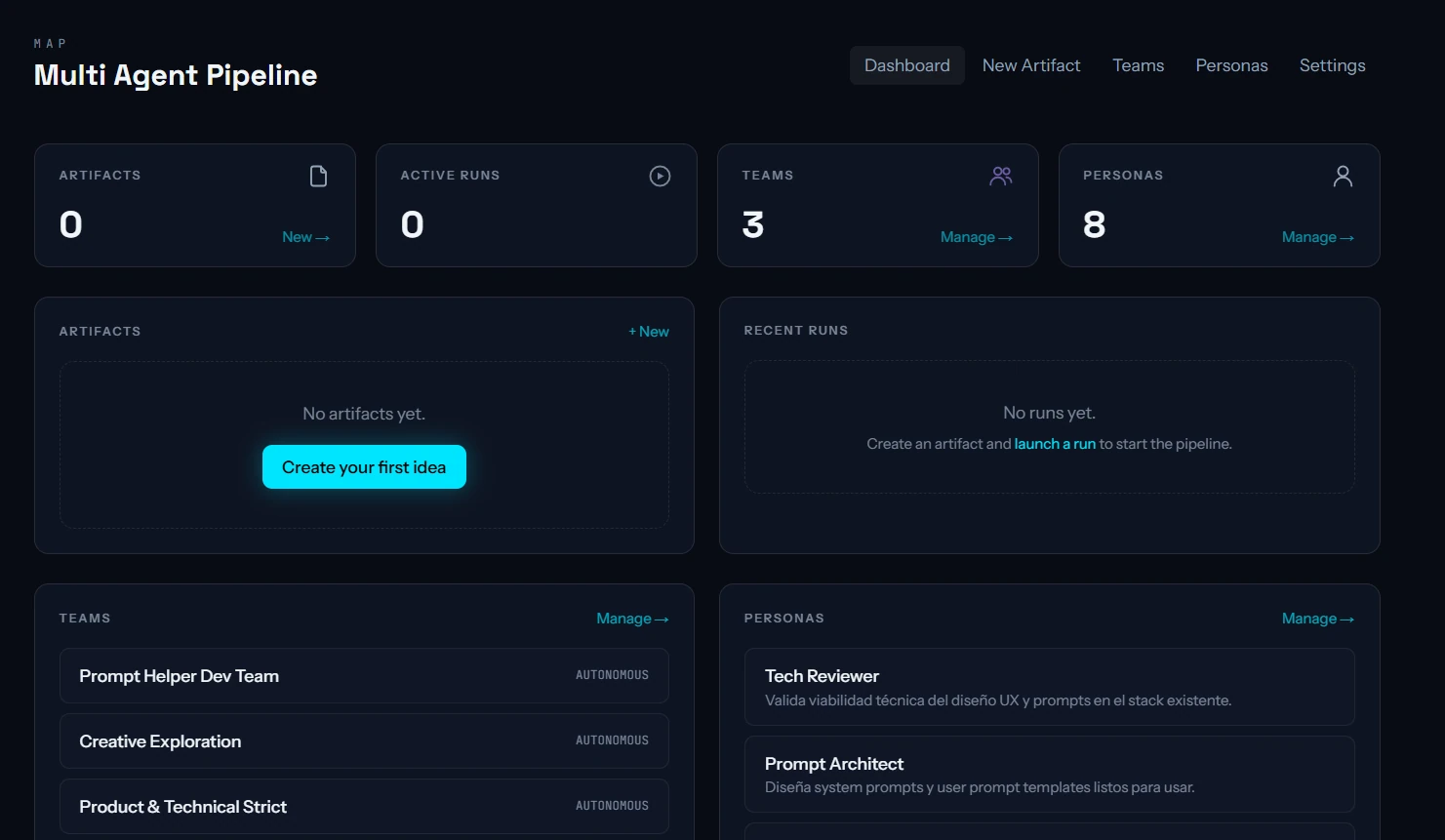
From a raw idea to a structured specification. Configurable AI teams work through sequential validation stages.
The problem
Using separate AI chats to develop an idea means repeatedly asking a model to act as a designer or evaluator. Someone has to copy the designer's output to the evaluator, carry the feedback back, and keep the context aligned. Adding more reviewers makes that manual coordination harder.
The solution
MAP automates that multi-agent workflow: configurable AI teams and personas move an idea through sequential validation stages to produce detailed, structured specifications. Versioned artifacts and frozen prompt snapshots keep the outputs and prompts associated with each run.
My responsibility
The documented project scope covers multi-agent orchestration, API endpoints, and a relational data model. This account does not break down individual and team responsibilities, so it does not claim sole ownership of those components.
Constraints
- Runs need reproducible context: configurable personas, versioned artifacts, and frozen prompt snapshots are part of the orchestration engine.
- Validation happens in sequential stages, with configurable AI teams rather than a single unstructured response.
Technical decisions
Turn ideas into specifications
A configurable multi-agent pipeline moves raw ideas through sequential validation stages to produce structured specifications.
Keep each run reproducible
The orchestration engine supports configurable personas, versioned artifacts, and frozen prompt snapshots.
Build a structured foundation
More than 20 API endpoints and a relational schema with over 10 models support the workflow, using PostgreSQL, Prisma, and Redis.
Outcomes and evidence
- The documented implementation includes more than 20 API endpoints and a relational schema with over 10 models.
- The pipeline supports configurable personas, versioned artifacts, and frozen prompt snapshots across its validation workflow.
This account is based on the existing project notes. They describe implementation scope, not usage or output-quality metrics. No public source repository or live demo is linked for MAP.