Workbench
From furniture ideas to buildable plans
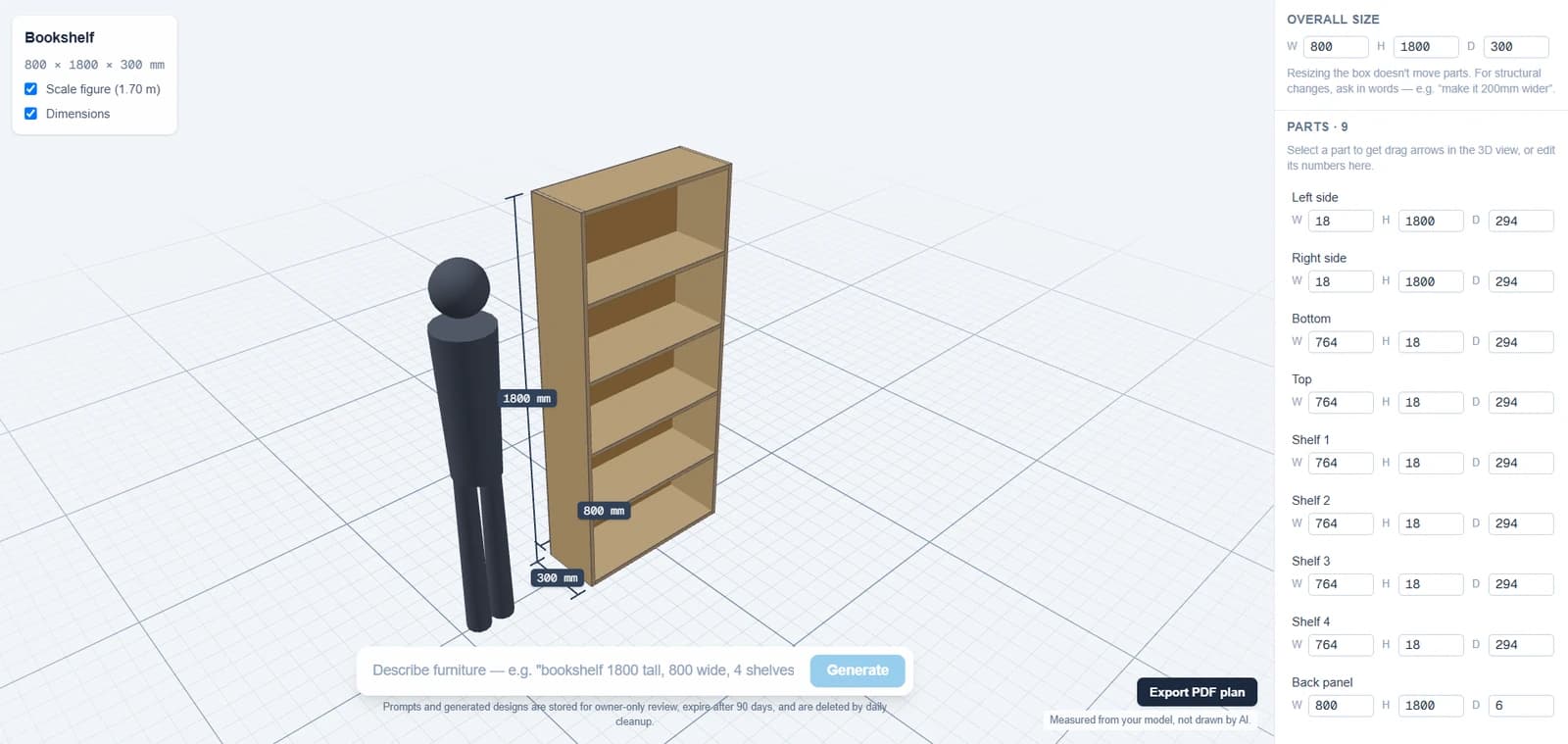
Turn a furniture idea into an editable 3D model, dimensioned plans, and a cut list. AI creates the specification; validated measurements drive the output.
The problem
Explaining custom furniture to a woodworker or designer can leave room for misunderstanding. The customer may imagine one size, layout, or set of details while the maker understands another, so the delivered piece may not match what the customer had in mind.
The solution
Workbench lets users describe furniture in plain language, refine the design with an LLM, and inspect an editable 3D model before exporting dimensioned blueprints as a vector PDF and a cut list. The preview, dimension chains, and cut list all use the same validated measurements.
My responsibility
I built the LLM pipeline that turns natural-language descriptions into editable 3D furniture models, with streamed generation, validation, and retries. I also implemented database-backed usage quotas and generation logging with a private dashboard.
Constraints
- The 3D preview, dimension chains, and cut list must use the same measurements. Generated specifications pass schema and geometry checks before driving those outputs.
- Production AI generation requires an invite key and uses database-backed usage quotas.
Technical decisions
Describe and refine
Describe furniture in plain language, preview a parametric 3D model, then change dimensions or refine the design in words. Parts can be selected and edited, with undo and redo support.
Keep measurements consistent
The model returns a structured specification that passes schema and geometry checks, with automatic retries driven by validation feedback. The 3D preview, dimension chains, and cut list are derived from the same measurements rather than drawn by AI.
Export plans for the workshop
Export a vector PDF with an isometric view, scaled plan, front and side views, dimension chains, and a grouped cut list. Production AI generation requires an invite key.
Outcomes and evidence
- The implemented workflow supports editable parametric models, dimensioned vector PDF exports, and grouped cut lists.
- Database-backed usage quotas and generation logging track tokens, latency, retries, and outcomes in a private dashboard.
The resume documents the generation pipeline and logging; the project notes describe the editing and export workflow. This case study does not publish the collected figures or claim improved generation quality or workshop results. Source code and a live demo are linked below.